|
Share Article
You’ve been logging every meal, hitting your macros, drinking your water, and yet the scale hasn’t moved.
So now you’re wondering: is any of this even working? It is. You’re just measuring the wrong thing.
Weight bounces around by 2-5 pounds on any given day. The scale definitely doesn’t tell you that your energy is up, your cravings are down, or that your protein consistency just hit a three-week streak.
That’s the nutritional data that actually matters, and your food tracking app is already collecting all of it.
This blog article is about shifting your focus. We’ll show you exactly what to track beyond the scale, so you can see how much progress you’re really making and build a relationship with food that actually sticks.
Why the Scale Doesn’t Tell the Whole Story
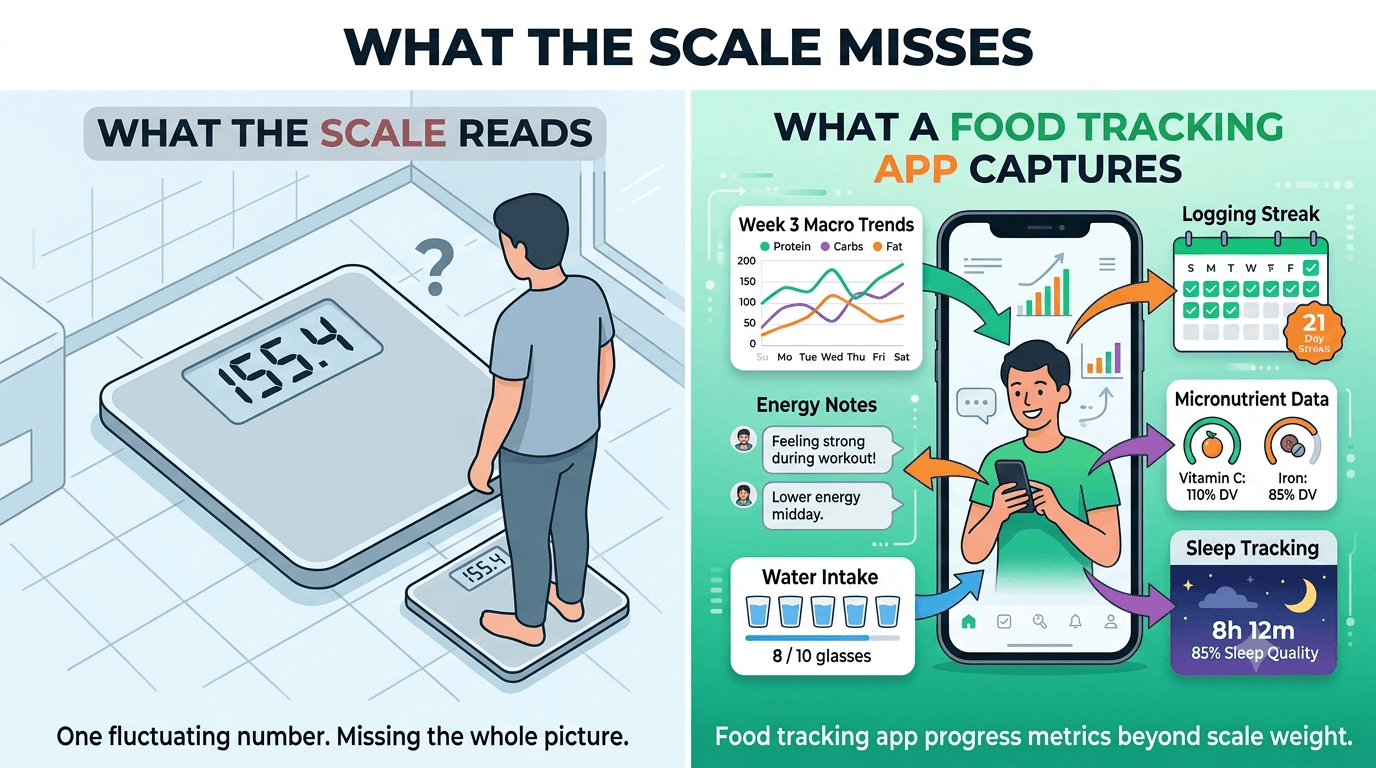
Let’s be real about what a bathroom scale actually measures: total mass. That’s it.
It can’t tell fat from muscle from water from the chicken breast you had for dinner. It has no idea you’re mid-cycle, or that you ate salty takeout yesterday, or that you’ve been crushing your hydration goals all week.
In reality, it’s usually the first thing people check to decide if their food tracking app is “working.”
As mentioned in the introduction, weight swings 2-5 pounds in a single day for reasons that have nothing to do with fat. Usually, it’s because of the following:
Water retention from sodium
Glycogen from a carb-heavy meal
Hormonal shifts
Undigested food
It’s one data point, one moment, with zero context.
Meanwhile, your food tracking app is quietly collecting data that actually tells you something. It tells you about macro consistency, protein trends, meal timing, and food variety. None of that shows up on the scale, yet all of it shapes your health.
The point isn’t to ditch the scale entirely. It can be useful, as one data point among many. The goal is to stop treating it as a verdict and start looking at the full picture your app is already painting for you.
What Non-Scale Victories Actually Are and Why They Matter
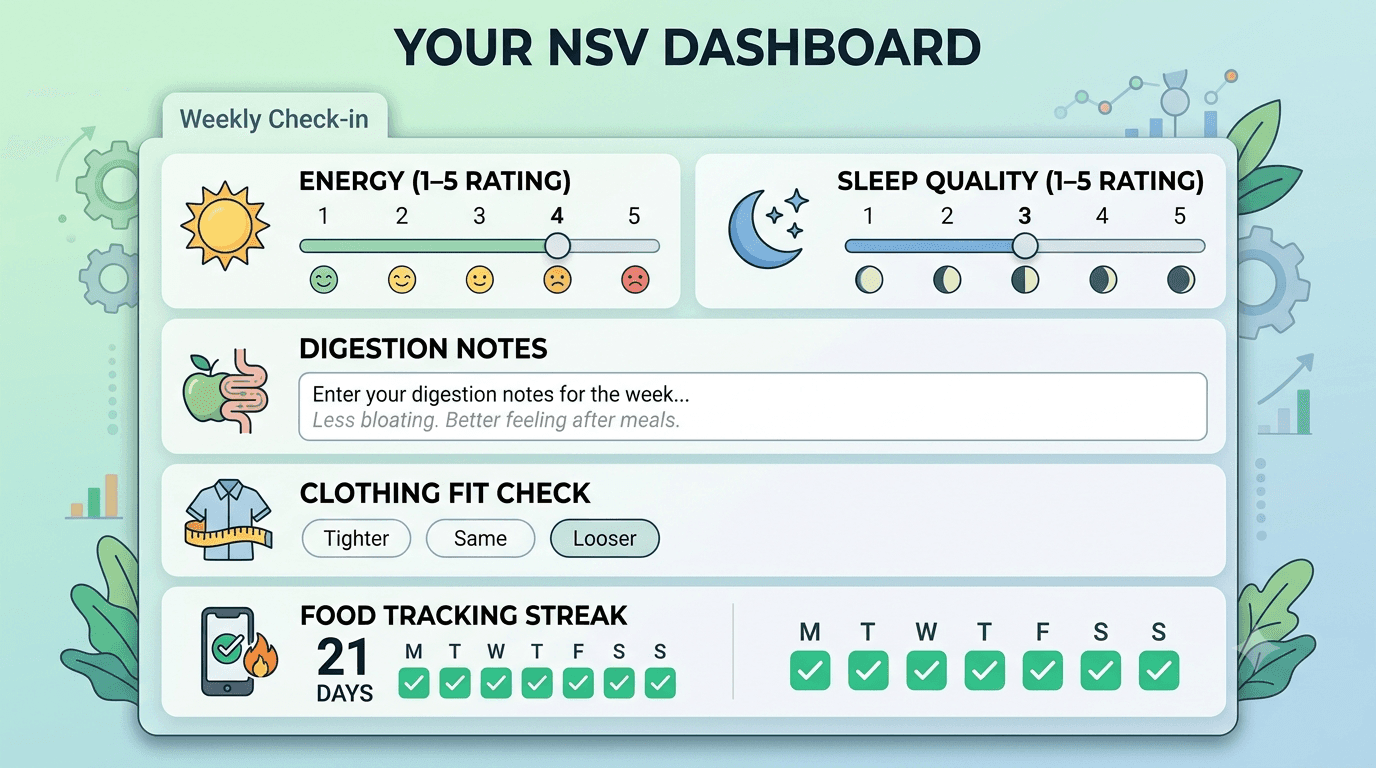
Non-scale victories (NSVs) are exactly what they sound like: real improvements in your health that have nothing to do with pounds lost. Some examples are the following:
Feeling less bloated after meals
Climbing stairs without dying
Sleeping through the night
Logging three days in a row without skipping
Seriously, research found that people who tracked NSVs were three times more likely to maintain their progress after a year than people who only watched the scale. This makes total sense because when the only win condition is “the number went down,” you’re stuck in a constant pass/fail loop.
So, the second the scale plateaus, you feel like you’re failing.
But when you’ve got multiple ways to measure progress, something is always moving in the right direction.
The Metrics Your Food Tracking App Already Collects
One of the most underused features of any food tracking app isn’t some premium add-on. It’s the basic history and trend data that’s already sitting in your dashboard.
Here’s what to look at:
Logging consistency
How many days in a row have you logged your meals? Consistency is the single biggest predictor of results.
A 2019 study published in Obesity found that people who logged meals at least three times daily lost 64% more weight over six months compared to infrequent loggers. The streak itself is progress.
Macro averages over time
A single day’s macros mean almost nothing. A weekly or monthly average tells you something real. If your average protein intake has gone from 80g to 120g per day over the past month, that’s a major win for body composition, whether or not the scale has moved.
Calorie consistency
Hitting your calorie target within a reasonable range day after day is a skill. It builds slowly.
Once you see that your day-to-day variance has tightened up over a month, you’re already developing real nutritional awareness.
Micronutrient trends
Apps like Biteme let you track up to hundreds of nutrients. Most people are chronically low in fiber, iron, magnesium, and vitamin D without realizing it. Watching those gaps close over weeks of intentional eating is meaningful health progress.
Water intake
This is a simple metric, but important. Most food tracking apps include hydration logging. Consistent hydration directly affects energy, hunger cues, digestion, and skin health — all things people want to improve but rarely connect back to what they’re logging.
Stop treating your food log as a one-way calorie ledger. It’s a health journal. The data is already there. You just have to look at it.
How Meal Logging Builds Mindful Eating Habits
There’s a version of food tracking that’s obsessive, rigid, and exhausting. Then there’s the version that quietly changes how you think about food. Not through restriction, but through awareness.
The difference is what you do with the data.
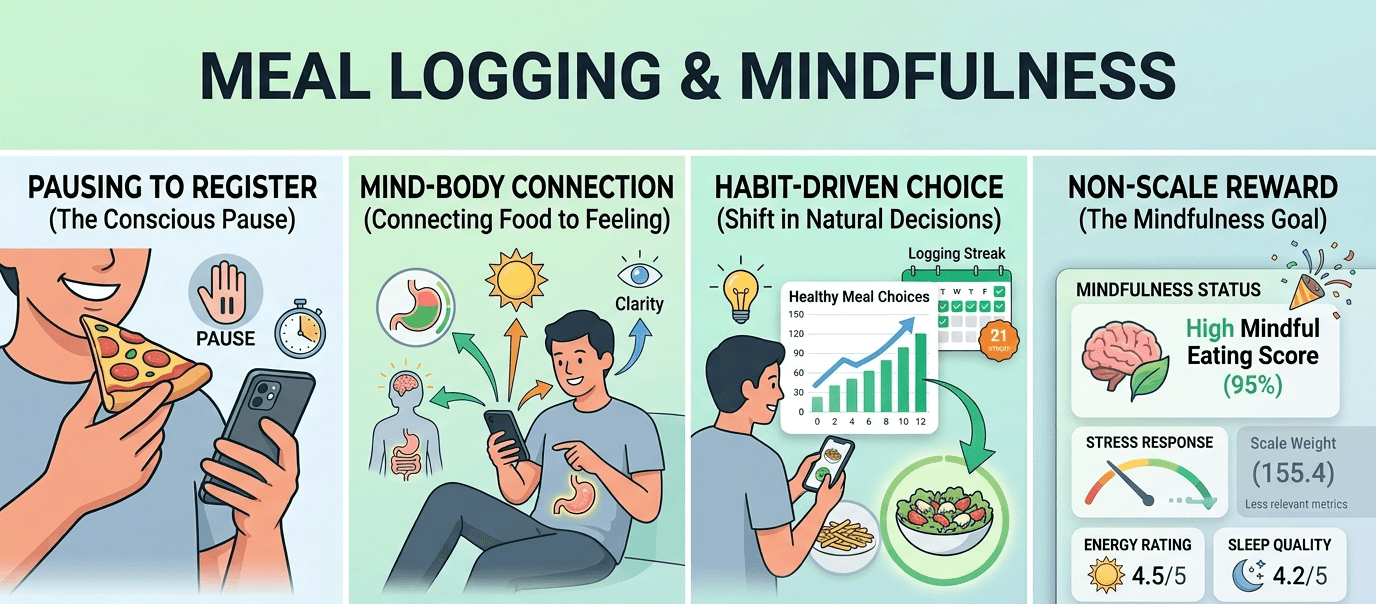
When you log consistently, something shifts. You start making slightly different choices. It’s not because the app told you to, but because you’re paying attention.
That’s mindful eating in practice. Not the slow-chewing, raisin-meditation version from wellness blogs. Instead, it’s a real, practical shift in how conscious you are of what you’re eating.
Research on food journaling shows that logging itself, independent of any calorie targets, leads to better food choices. People who journal without calorie counting report better portion awareness and less mindless eating.
For food tracking app users, that means your most important metric might not be whether you hit your calorie goal today. It might be whether you paused before logging and actually noticed what you were eating. That pause is the habit that makes change stick.
One practical tip is to use the notes feature in your app to jot down why you made certain choices. “Ate pasta because I was stressed.” “Chose the salad because I felt good and wanted to keep it going.” Those notes build up over time and start revealing patterns that actually shift your relationship with food.
Progress Photos and Body Measurements
The scale measures weight. Progress photos and body measurements measure shape. They’re not the same thing, and the difference matters.
Body composition (the ratio of fat to muscle) can shift a lot even when the scale doesn’t move. That’s because muscle is denser than fat. You can lose inches, notice your clothes fitting differently, and look visibly different in photos while your weight stays basically flat.
Here are a few ways to track what’s actually changing:
Monthly progress photos
Same lighting, same time of day, same outfit. You don’t have to share them with anyone. But pulling up a photo from eight weeks ago can show you changes you’ve stopped seeing in the mirror. When you look at yourself every day, you stop noticing the shift.
The clothes test
Pick something that fits a little tight right now. Try it on every few weeks. It’s low-tech, free, and honestly more satisfying than most numbers on a screen.
Waist circumference
A tape measure costs nothing. Losing inches around your middle has been directly linked to lower cardiovascular risk, regardless of what the scale says. Check it monthly.
Functional markers
Can you do more pushups than last month? Make it up the stairs without losing your breath? That’s your body getting stronger, and it counts.
When you stack this alongside your food tracking data, you start seeing actual cause and effect. That’s the kind of progress that keeps you going.
How to Use Your Food Tracking App to Celebrate These Wins
Here’s the practical piece: most food tracking apps aren’t explicitly built to celebrate non-scale victories. But you can use them that way with a few simple adjustments.
Use the notes feature as a win journal
Screenshot your streaks
Set custom goals beyond calorie targets
Use the weekly/monthly summary view
Sync with wearables for a fuller picture
Key Takeaways
Are you tracking progress beyond the scale? What non-scale victories have surprised you the most on your food tracking journey?
Start today: Open your food tracking app right now and look at last week’s averages. Pick one non-scale metric to pay attention to alongside your weight for the next 30 days. See what you notice.
If you’re looking for an all-in-one, interactive food tracking app, download Biteme today!
Share Article
Recent Posts

